One, two buckle my shoe, three, four shut the door…We all know how it goes. But what are these one and two and three and four? As students, we learned that they are Arabic numerals. But we had learned wrong. If you rewind the chronicler’s tape a couple of centuries before the Islamic Golden Age (8th century CE – 14th century CE), you’ll find these symbols found their home in modest Indian allies by the 6th century CE. And yet, most of the world and even most Indians err in its origin.
India-based Scottish historian and author William Dalrymple believes that it is because India has never been great at promoting itself. “I’m baffled by it, but it’s true. No one outside India knows names like Aryabhatta and Brahmagupta. But every single one of them will know about Pythagoras and Archimedes. People should look at why that is. That’s one of the things this book is trying to do – make the case for this export of Indian ideas. The lack of which is why you get those WhatsApp forwards about nuclear weapons in the Mahabharata. People know this is a great culture. But they don’t have the raw information to flesh it out into facts. The true story is extraordinary. You don’t need to make anything up,” says Dalrymple.
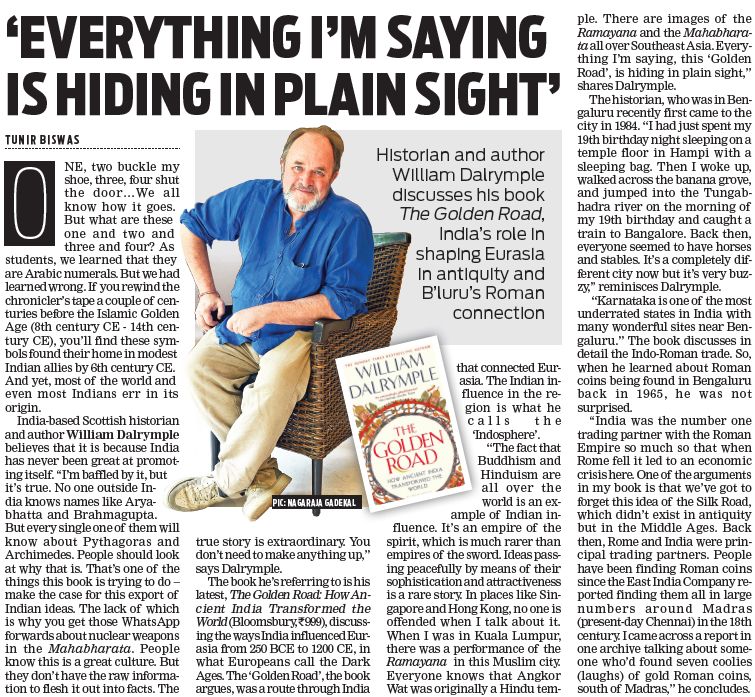
The book he’s referring to is his latest, The Golden Road: How Ancient India Transformed the World (Bloomsbury, `999), discussing the ways India influenced Eurasia from 250 BCE to 1200 CE, in what Europeans call the Dark Ages. The ‘Golden Road’, the book argues, was a route through India that connected Eurasia. The Indian influence in the region is what he calls the ‘Indosphere’.
Read more.


Leave a comment