Remember, remember the fifth of September’ might have been the opening line to that iconic Guy Fawkes rhyme (it starts as ‘Remember, remember the fifth of November’) if it was based on events that unfolded in Bengaluru in the new millennium. Unlike the Gunpowder Plot in 1605, a failed assassination attempt of British King James VI, the assassins in India succeeded in brutally killing renowned journalist and activist Gauri Lankesh outside her Bengaluru home on September 5, 2017.
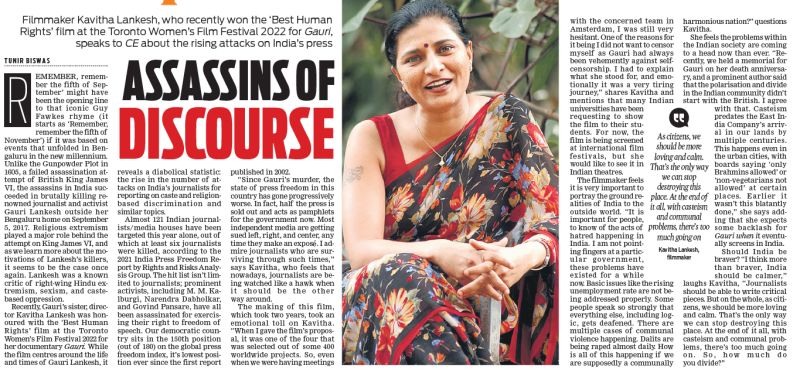
Religious extremism played a major role behind the attempt on King James VI, and as we learn more about the motivations of Lankesh’s killers, it seems to be the case once again. Lankesh was a known critic of right-wing Hindu extremism, sexism, and caste-based oppression. Recently, Gauri’s sister, director Kavitha Lankesh, was honoured with the ‘Best Human Rights’ film at the Toronto Women’s Film Festival 2022 for her documentary Gauri.
While the film centres around the life and times of Gauri Lankesh, it reveals a diabolical statistic: the rise in the number of attacks on India’s journalists for reporting on caste- and religion-based discrimination and similar topics. Almost 121 Indian journalists/media houses have been targeted this year alone, out of which at least six journalists were killed, according to the 2021 India Press Freedom Report by Rights and Risks Analysis Group.
The hit list isn’t limited to journalists; prominent activists, including M. M. Kalburgi, Narendra Dabholkar, and Govind Pansare, have all been assassinated for exercising their right to freedom of speech. Our democratic country sits in the 150th position (out of 180) on the global press freedom index, its lowest position ever since the first report was published in 2002.
“Since Gauri’s murder, the state of press freedom in this country has gone progressively worse. In fact, half the press is sold out and acts as pamphlets for the government now. Most independent media are getting sued left, right, and centre any time they make an exposé. I admire journalists who are surviving through such times,” says Kavitha, who feels that nowadays, journalists are being watched like a hawk when it should be the other way around.
Read more.


Leave a comment